Why Send Ads to a Dedicated Landing Page?
Key Takeaways:
- A dedicated landing page keeps the ad, offer, audience, and next step aligned.
- Google has made landing page relevance and navigation part of the ad quality conversation, which means the post-click experience can affect more than conversion rate.
- Sending every campaign to a homepage or generic product page makes it harder to control what the buyer sees, clicks, and understands.
- A campaign-specific page gives you cleaner data because you know who the page was built for and what action you wanted them to take.
- The best landing pages do not remove every path. They remove the wrong paths and make the right next step easier to choose.
The Problem With Sending Paid Traffic to a Generic Page
When someone clicks an ad, they are not starting from scratch. They have already seen a message, made a small decision, and formed an expectation about what comes next. The landing page has to pick up that thread immediately.
That is where a lot of paid traffic breaks down. The ad promises one thing, then the click sends people to a homepage, a product overview, or a page built for several audiences at once. The visitor has to translate the ad into the site structure, find the relevant section, decide whether the offer is still available, and figure out what action to take.
That may sound minor from inside the company. To a buyer, it feels like work. And in paid media, every extra bit of work creates a reason to leave.
A dedicated landing page gives the campaign its own post-click experience. It does not have to be stripped down, gimmicky, or disconnected from the rest of the website. It simply has to be built for the specific promise, audience, offer, and decision behind the ad.
That is the real reason to send ads to a dedicated landing page: it gives you control over the moment after the click.
The 4Ps of Sending Ads to a Landing Page
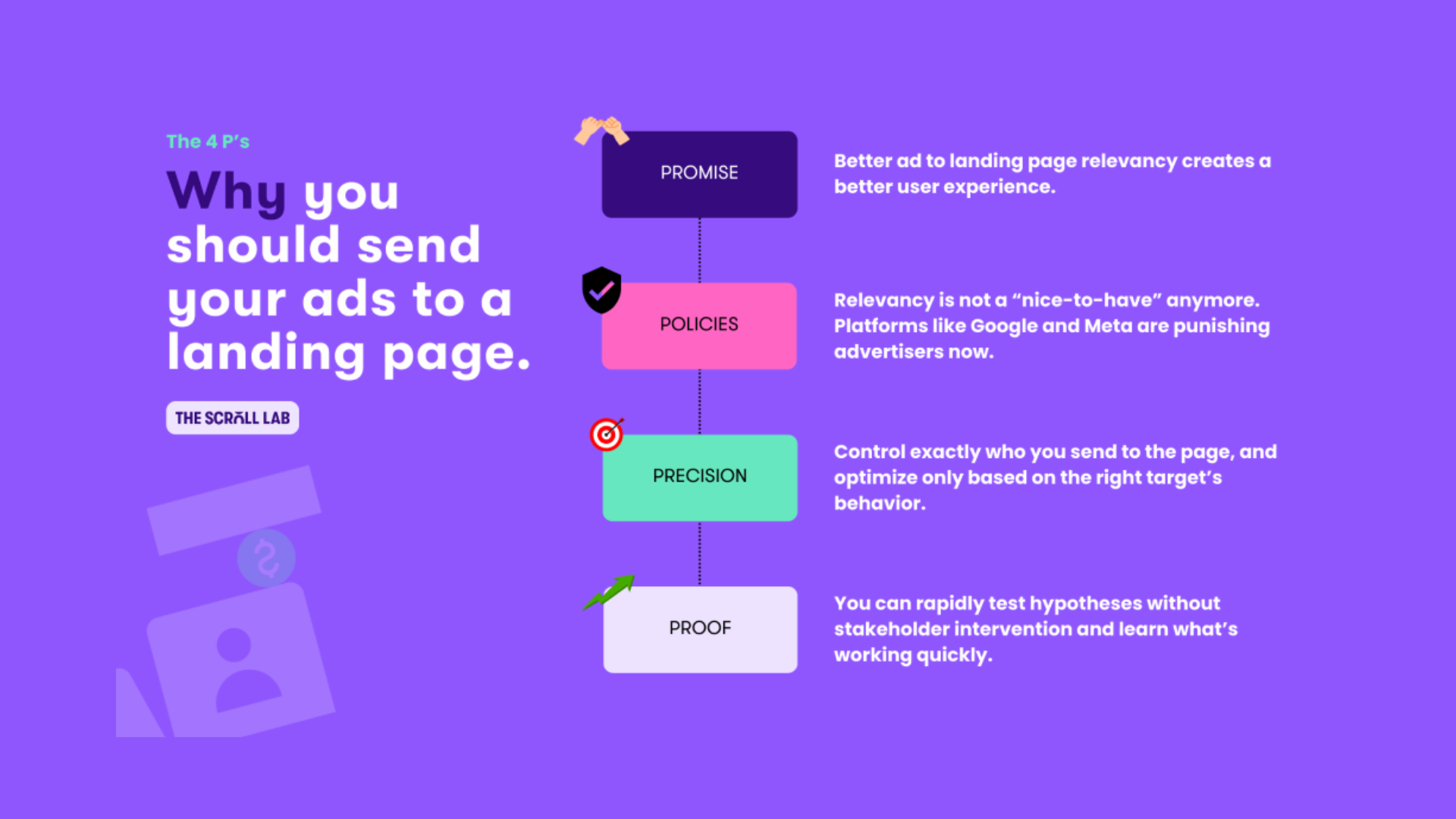
I think about this through four practical reasons: Promise, Policies, Precision, and Proof.
Think of these as practical business reasons. They explain why a dedicated page is often a better decision than sending paid traffic to whatever page already exists.
1. Promise: The Page Should Continue the Ad
Every ad makes a promise. Sometimes the promise is explicit, like "Get the benchmark report" or "See how teams reduce demo no-shows." Sometimes it is implied through the pain point, audience callout, stat, product claim, or offer.
The landing page has to continue that promise. If the ad speaks to VP-level marketing leaders who are trying to improve landing page conversion, the page should not open with a generic product headline written for every possible buyer. If the ad promotes a checklist, the page should not make people hunt for the checklist behind a navigation menu. If the ad says the buyer can compare options, the page should make comparison the obvious path.
This is where dedicated landing pages help. They let you match the language, offer, and order of information to the ad that brought the person there. The page can answer the question the ad created instead of forcing the visitor into a broader site experience.
Google also frames this as a user experience issue. In its February 2025 Ads & Commerce post, Google explained that it had refined its ads quality systems to better understand whether a search ad leads to an unexpected destination or a page that does not offer helpful navigation options. Google specifically called out the frustration of clicking an ad and landing somewhere that does not match what the person expected or makes the next step hard to find. Source: Google Ads & Commerce Blog.
For marketers, the lesson is practical. The landing page should not make the buyer rebuild the context from the ad. It should make the next step feel like the natural continuation of the click.
2. Policies: Relevance Is Now Part of the Platform Conversation
Landing page relevance used to be treated mostly as a conversion topic. Better message match usually meant better conversion rates, so marketers cared about it when performance dropped.
Now it is also a platform topic.
Google's own Quality Score documentation says landing page experience is one of the three components used to calculate Quality Score, alongside expected clickthrough rate and ad relevance. Google defines that component around how relevant and useful the landing page is to people who click the ad. Source: Google Ads Help.
Google's guidance on improving Quality Score also tells advertisers to give people what they are looking for, keep messaging consistent from ad to landing page, make the website mobile friendly, and improve loading speed. It also notes that navigation matters more on mobile, where visitors have less patience for hunting through a site. Source: Google Ads Help.
A platform-aware landing page does not need to be tiny or stripped of every navigation path. That interpretation is too simplistic. The real requirement is that people should be able to find what they expected to find. That distinction matters.
A dedicated landing page can still include helpful navigation, trust paths, comparison links, FAQ sections, product details, and legal or policy information. The question is whether those paths support the campaign intent or compete with it. A homepage has to serve everyone. A dedicated landing page can serve the person who clicked this ad.
If platforms are paying closer attention to relevance and navigation, marketers need to stop treating the landing page as an afterthought. It is part of the ad experience.
I partnered with Unbounce to do a breakdown of the ad policies and how to implement them on existing and new landing pages.
3. Precision: Control Who You Send to the Page and What You Learn
One of the biggest advantages of a dedicated landing page is precision.
When you send a campaign to a generic page, you inherit every decision that page was built to support. The messaging may be aimed at multiple personas. The CTAs may serve different funnel stages. The proof may be too broad. The navigation may pull visitors into parts of the site that have nothing to do with the campaign.
That makes the data harder to read.
If conversion rate is low, was the offer wrong? Was the audience wrong? Was the page too broad? Was the headline weak? Was the CTA mismatched? Was the visitor distracted by another path? When the destination page is serving too many jobs, it becomes harder to diagnose what happened.
A dedicated landing page gives you a cleaner test environment. You can build the page around a specific audience, campaign promise, offer, and primary action. Then the performance data has more context.
For example, imagine a company running ads to promote a webinar about reducing customer churn. Sending that traffic to a general resources page creates a messy experience. The visitor may see blog posts, reports, webinars, guides, product pages, and several CTAs. A dedicated page can focus on the webinar promise, explain who it is for, show the agenda, answer the biggest objection, and make registration the clear next step.
That does not guarantee the page will convert. It does make the result easier to interpret.
If the dedicated webinar page gets plenty of qualified traffic but weak registrations, you can look at the offer, proof, friction, or audience fit. If the generic resources page performs poorly, you are left guessing whether people even found the webinar.
Precision also means creating a page where the buyer's behavior means something.
4. Proof: Dedicated Pages Help You Test Faster
Marketing teams often want to learn quickly, but the website is rarely built for fast learning. Website pages usually have more stakeholders, more dependencies, and more internal politics. A small change to a product page can turn into a cross-functional review.
Dedicated landing pages reduce that friction.
You can test a headline tied to a specific pain point. You can test whether a demo CTA performs better than a guide for a certain audience. You can test a shorter page against a proof-heavy page. You can test whether the buyer needs a comparison section, a pricing cue, or a stronger explanation of what happens after they convert.
That speed matters because paid campaigns give you feedback quickly. If you have to wait weeks to update the destination page, you lose the advantage of that feedback loop.
The page becomes the place where campaign strategy meets buyer behavior. You can see whether the promise resonates, whether the offer carries enough value, whether the proof answers the right doubts, and whether the next step feels clear.
This is also why a dedicated landing page should be more than a prettier form. It should be a controlled expression of the hypothesis behind the campaign.
The hypothesis might be:
- This audience cares more about speed to launch than cost savings.
- This offer is strong enough for cold traffic.
- This problem-aware segment is ready for a demo.
- This market needs proof before it will take action.
- This ad promise needs a comparison page, not a product overview.
When the page is built around the hypothesis, the data can teach you something useful.
What a Dedicated Landing Page Should Actually Do
A dedicated landing page works best as a focused bridge between the ad and the next step. It gives the buyer the right amount of context for the action you are asking them to take.
That usually means the page needs to answer a few basic questions:
- Am I in the right place?
- Is this the thing I clicked for?
- Who is this for?
- Why does this matter now?
- What will I get or what happens next?
- What proof makes this credible?
- What action should I take?
- Where can I go if I need one more piece of information?
The last question is important. Some marketers hear "dedicated landing page" and assume the page should remove every possible path except the form. That can work for some offers, but it can also create a worse experience when the buyer needs context.
If someone clicks an ad looking for product pricing, documentation, login access, or a specific offer, hiding the helpful path makes the page harder to use, even when the layout looks focused.
The better approach is to design the page around intent. Keep the primary action clear. Add supporting paths only when they help the visitor make the decision you brought them there to make.
When a Homepage or Existing Page Might Be Enough
There are cases where sending ad traffic to an existing page is reasonable.
If the ad is branded search and the person is clearly trying to find your company, the homepage may be fine. If the ad promotes a specific product and the product page already matches the campaign promise, has a clear CTA, loads quickly, works well on mobile, and answers the right objections, you may not need a new page.
But those are conditions to check, not assumptions to make.
Before sending paid traffic to an existing page, ask:
- Does the page continue the exact promise from the ad?
- Is the primary CTA right for this audience and offer?
- Does the page answer the question that made the person click?
- Is the proof relevant to this campaign?
- Are there paths that pull the visitor away from the intended action?
- Can we tell what worked or failed from the data?
If the answer is unclear, a dedicated landing page is usually the cleaner option.
A Practical Checklist Before You Send Ads to Any Page
Use this before launching a paid campaign.
- Match the ad promise to the page headline and opening section.
- Make the offer obvious above the fold.
- Use the same language the buyer saw in the ad, without copying every word mechanically.
- Choose one primary CTA that matches the buyer's stage.
- Explain what happens after the click or form fill.
- Include proof that supports this specific campaign.
- Keep navigation paths that help the buyer, and remove paths that distract from the decision.
- Check the mobile experience before launch.
- Make sure the page loads quickly enough for paid traffic.
- Set up tracking so page behavior can be tied back to the campaign.
- Decide what you are trying to learn before you launch.
This is where the 4Ps come together. Promise keeps the experience aligned. Policies keep you honest about platform expectations. Precision gives the buyer a path built for them. Proof helps you learn what is working.
Final Thought
Sending ads to a dedicated landing page means treating the click as a specific moment with a specific expectation.
The buyer gave you a moment of attention because the ad created a specific expectation. The page should honor that expectation, make the next step easy to understand, and give your team a cleaner way to learn from the campaign.
That is the value of a dedicated landing page. It turns the post-click experience into part of the strategy, instead of leaving it as the place where good ads go to lose momentum.
FAQs
What is a dedicated landing page?
A dedicated landing page is a page built for a specific campaign, audience, offer, or conversion goal. It is different from a homepage or general product page because the message, proof, CTA, and page structure are designed around one post-click experience.
Why should paid ads go to a landing page instead of a homepage?
Paid ads should usually go to a landing page when the ad creates a specific expectation. A dedicated page can continue the ad promise, explain the offer, guide the buyer to one primary action, and give the marketing team cleaner performance data.
Does Google care about landing page experience?
Yes. Google says landing page experience is one of the three components used to calculate Quality Score for Search campaigns. Google also recommends keeping messaging consistent from ad to landing page, making pages mobile friendly, improving load speed, and giving people what they are looking for.
Should landing pages remove navigation?
No. A landing page should remove distracting paths, but it can still include helpful navigation when visitors need it to complete their task. The goal is to make the right next step clear without trapping the visitor on the page.
When should I use an existing website page for ads?
Use an existing page when it already matches the ad promise, serves the campaign audience, has the right CTA, provides relevant proof, works well on mobile, and gives you clear enough data to judge performance. If the page is too broad, build a dedicated landing page.