3 Ways to Get Users to Actually Read Your Landing Page
Key Takeaways:
- Most landing pages fail to engage because they’re hard to scan and harder to understand, not because of short attention spans.
- Plain language and buyer-focused content give prospects a clear reason to keep scrolling and see how they can benefit from your solution.
- Specific, credible testimonials build trust faster than feature lists or brand-driven messaging ever will.
You've done it. You've put in the time to coordinate copy writing, design work, and optimize your layout. Your landing page is live. But now you're seeing that most of your prospects aren't scrolling past your first block. What do you do next?
While it’s easy to blame short attention spans, simple factors like page structure have a greater impact on engagement than many B2B SaaS companies realize.
Landing pages often make it harder than it has to be for prospects to understand how you can help them. Without a clear reason to stay, many people bounce from the page within a few seconds.
Finding the exact reason people quickly leave your page can be difficult, but the following three strategies should help you encourage users to stop, scroll, and read your landing page content.
Simplify your writing
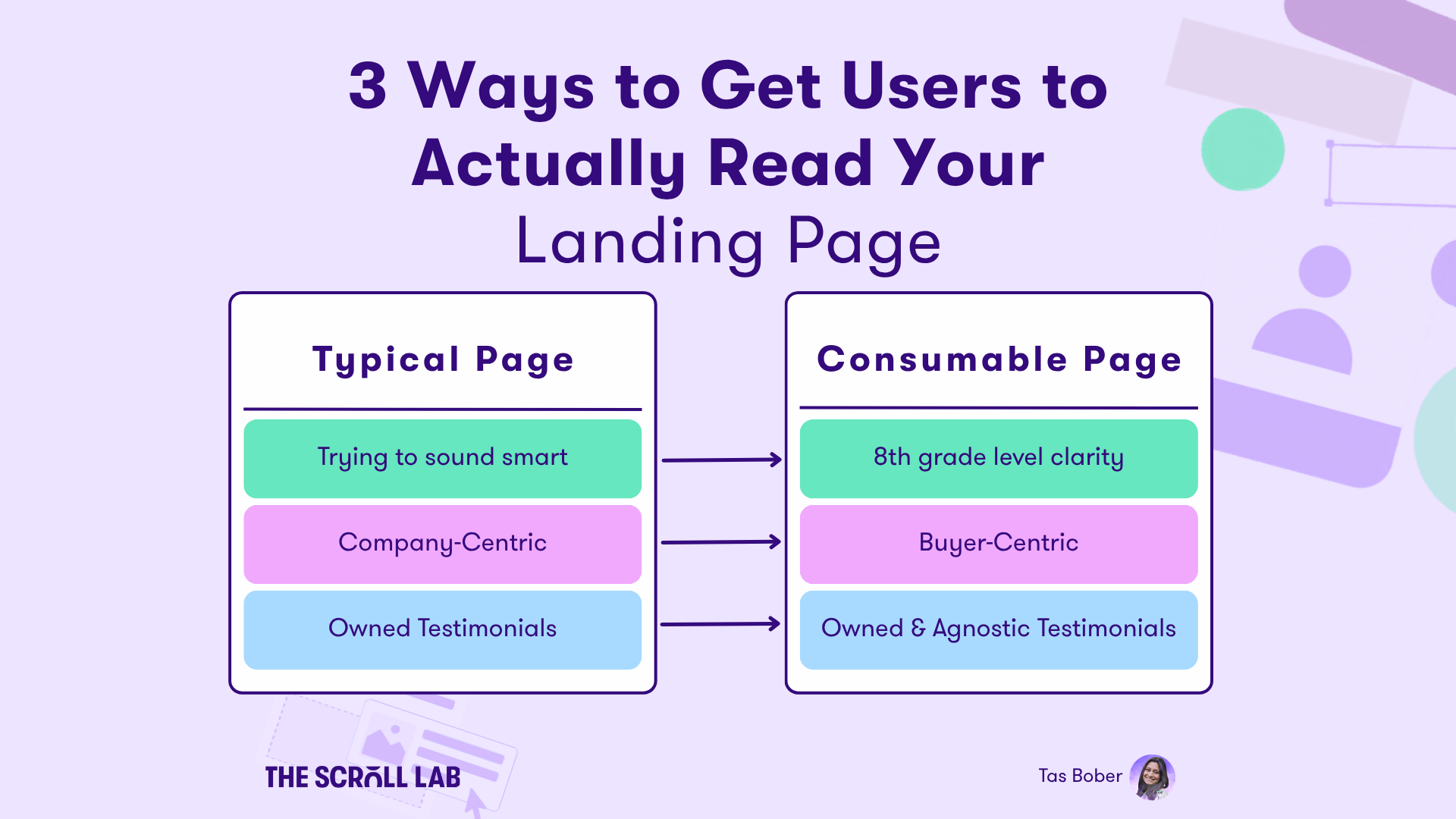
Most U.S. adults read at about an 8th grade level. Keep this in mind. Don't scoff at the idea of writing simply to meet people where they are. The easier you can make your page to understand, the more likely your prospects are to convert.
Your future customers don't want to put in extra work to understand what you're trying to say. Industry jargon and overly technical explanations of your product may be hurting your ability to connect with a visitor.
When you write your landing page copy, your goal should be to deliver simple, clear messages. Avoid trying to be too clever or writing something because “it sounds cool.” Instead, try to use plain language with short sentences and common words.
Write from the Angle of the Buyer
This point should be obvious, but you'd be surprised how many B2B SaaS brands miss the mark on buyer-focused content. They often fall into the trap of talking too much about their own company and not enough to their buyers.
If your current pages are filled with items like company awards, product features, “Why we’re the best” claims, or competitor tear-down content, you’re talking about yourself, not the buyer.
Each section of your page should speak to your prospect. This allows them to picture themselves using your product. Try touching on the following items in your copy:
- The problems they’re dealing with
- The gaps in their current process
- Why your product was built for people like them
- Results from companies they recognize
Without these key elements, a buyer won’t see themselves on the page and will likely bounce.
Strengthen Your Customer Testimonials
It’s no secret that trust matters in conversions. Trust is gained through social proof—when your customers provide testimonies of how you helped them in their own words. But there is a difference between believable social proof and generic social proof.
Instead of using testimonials from your own customer surveys, try pulling them from third-party sites like G2, Reddit, and other forums—places your buyers hang out online. This helps your social proof feel more genuine.
The goal of social proof is to show how real people are talking about their experiences working with you, reducing friction and building trust. Your buyers are already seeing reviews about you elsewhere, so why not showcase them on your own page?
Here are a few ways you can make your testimonials even stronger:
- Show screenshots of actual reviews
- Include the title of the person (and make sure it matches your ICP)
- Link to the reviewer’s LinkedIn profile to show it’s a real person
- Feature company size or industry, if relevant
- Highlight quotes that are specific to real problems and benefits
For B2B SaaS, specificity sells. And specific testimonials do more work than any tagline ever could.
Keep It Simple, Direct, and Honest
Regardless of your product, reading a landing page should feel like skimming a note from a friend, not decoding a textbook. When you’re deciding between a cheeky headline and one that is direct, choose the one that is simple and direct.
The best landing pages aren't built to impress or make you look smart. They should help the buyer build the business case to champion your product or service internally.
FAQs
Why don’t users read most B2B landing pages?
Most users leave because the page is hard to scan, too complex, or focused on the company instead of the buyer.
What reading level works best for B2B landing page copy?
B2B landing pages perform best when written in clear, plain language that reads effortlessly, often at a 3rd- to 5th-grade level.
How can I make my landing page more buyer-focused?
Focus on the prospect’s problems, gaps in their current process, and real outcomes rather than company achievements or feature lists.
Do testimonials actually help users read and engage with landing pages?
Yes, specific testimonials from real customers and third-party sources build trust and encourage users to keep scrolling.
Where should B2B landing page testimonials come from?
Testimonials from third-party platforms such as G2, forums, or community sites are more believable than ones pulled from your own customer surveys.