3 Smarter Alternatives to Long B2B Forms
Key Takeaways:
- Long B2B forms fail because they create too much friction and signal a sales push too early.
- Smarter form structures, such as multi-step and progressive profiling, collect the same data without overwhelming prospects.
- Reducing friction upfront leads to higher conversions while still supporting qualified lead data later.
A landing page without a form is often ineffective and does your business a disservice. However, did you know that even landing pages with forms can fail?
For many B2B SaaS companies, the thought is “the more information we gather, the better.” And while data has power, most brands lose potential customers at the landing page stage simply because the forms are too long.
Unfortunately, many businesses don’t have the option to simplify the form to a name-and-email format. In many cases, the form acts as a guardrail to prequalify prospects and provide valuable information to the marketing and sales team.
So, how do you balance the need for client information with the customer’s desire for simplicity?
By reducing friction.
In the following sections, we’ll discuss why long B2B forms often fail and 3 alternative ways you can structure forms to make the process enjoyable for everyone.
Why Do Long B2B Forms Fail?
Although no one likes to admit it, as consumers, our attention spans have significantly decreased over the last five years. In the past, a prospect would spend time reading through articles and documents. But today, most people only skim headings until they find the content they’re looking for.
The same is true for landing pages.
Most landing page visitors will quickly scan the content and the form. While the copy might address their pain points, if the form is nothing but a series of required fields, it is likely to result in a failed conversion.
That isn’t to say data collection is bad for the company, but it could be harming lead gen efforts. If you have noticed a lack of form fills lately, there’s a chance it’s due to one of the following reasons:
- The process feels like work for the customer
- The request raises the stakes too early
- The form signals that the prospect is “Entering the sales funnel.”
The good news is that how you structure your form and ask your prospect for information can significantly improve conversions on the landing page.
3 Smarter Ways to Structure Your Forms
For B2B SaaS brands looking to maintain a robust prospect profile, long B2B forms aren’t the only way to acquire key information. Instead, the following strategies often yield higher engagement and conversion rates.
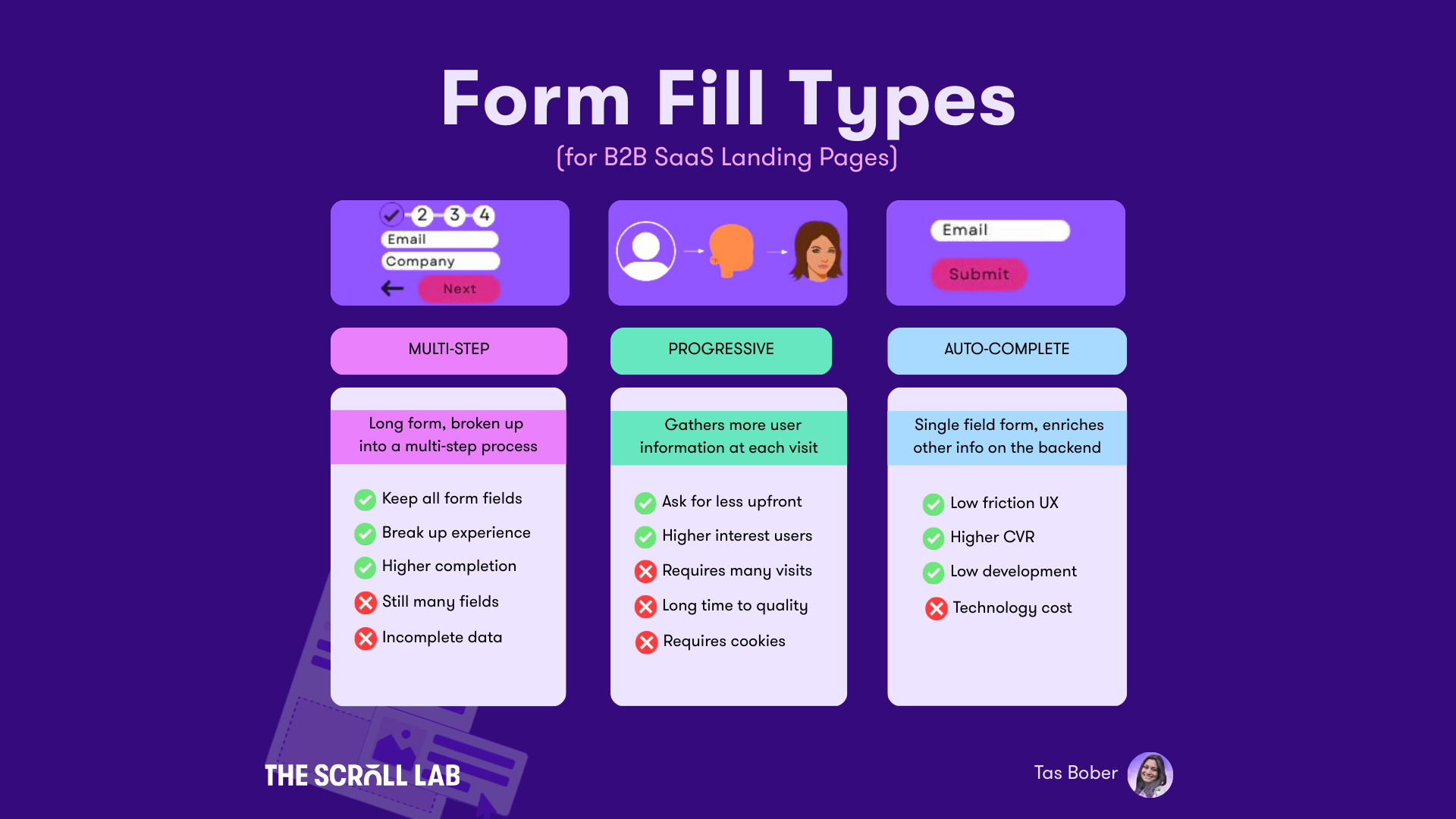
1. Multi-Step Forms
Multi-step forms are considered the closest alternative to traditional long-form structures. However, rather than overwhelming a prospect with 12 fields to fill out, these forms break questions into manageable steps or pages.
So, that long pre-qualifying form you're currently using could look like a few simple questions grouped together, followed by additional questions on another page.
Simply splitting the amount of data points into several small actions at a time will reduce friction and abandonment. It also activates the part of our brain that drives psychological biases, making prospects want to finish the rest of the form once it’s started.
Ultimately, multi-step forms are a wonderful option for B2B SaaS companies that need multiple data points for a complex offer, but want to improve the overall customer experience.
2. Progressive Profiling
Similar to multi-step forms, progressive profiling is another effective way to break down the initial lead generation process with a prospect.
This strategy entails asking only for basic information first, such as an email address and the potential client’s name. After you have the initial commitment and form filled out, the prospect is then introduced to further questions later in the funnel.
From a practical standpoint, this could look something like:
- Initial Form: (Name and Email)
- Introduction Email with Gated Content
- Gated Content Landing Page with Additional Form (Location, Industry, Position, Budget, etc.)
The progressive profile strategy works well because it focuses on natural interactions to gather data, rather than pressuring a prospect for all their information on the first visit.
3. Single Field + Enrichment
On the opposite end of the spectrum is the single-data-point approach. This strategy is among the most effective at eliminating friction, as it often requires only that prospects provide their email address.
Once you’ve collected the email, you work with backend enrichment tools like ZoomInfo, Clearbit, or 6sense to fill in the rest of the data.
In most cases, third-party software providers can supply sufficient firmographic data to create an accurate prospect profile. However, it’s important to monitor costs, as this approach can become expensive if you’re scrubbing a lot of data.
From Bounce to Conversion
Forms don’t have to be a pain point for your organization. They actually are incredibly useful tools, but only if you rethink how you ask for information, when you ask for it, and drill down on what data you honestly need at the top of the funnel.
No matter which strategy you use to collect data, the goal is always to reduce friction. Because even the best campaign in the world can’t save a form that makes users want to bounce.
FAQs
1. Why do long B2B forms hurt conversions?
Long forms feel like work, raise commitment too early, and signal immediate sales follow-up, which causes prospects to bounce.
2. What makes multi-step forms more effective than long forms?
They break questions into smaller steps, making the form feel easier to complete and increasing the likelihood that prospects finish it.
3. How does progressive profiling improve form performance?
It collects basic information first and gathers deeper details later through natural follow-up interactions.
4. When does a single-field form make sense?
Single-field forms work best when enrichment tools can supply firmographic data after an email is captured.
5. What’s the main goal of rethinking B2B form strategy?
The goal is to reduce friction early in the funnel so more prospects convert without sacrificing lead quality.